Before the lifeguards, before the resort, before the bridge, the first thing anyone built on Sandy Hook was a warning.
Feature
A Lighthouse, Raffled
How New York gambled its way to the oldest light in America — and bought four acres of Hartshorne sand to do it.
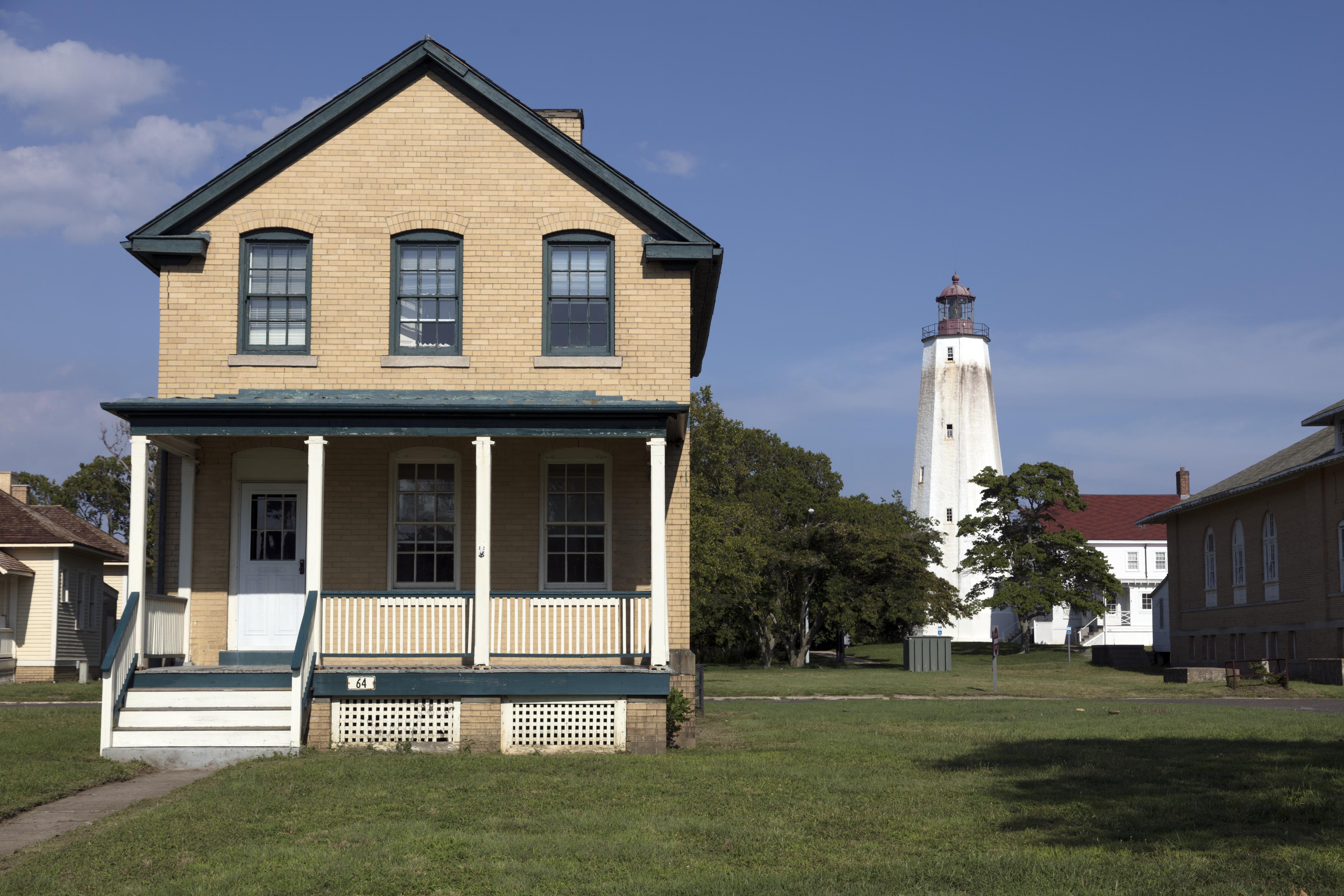
Carol M. Highsmith · Library of Congress · 2017 · public domain
You have to come at the Hook the way the ships did to understand why. Not down the Parkway and over the bridge, but in from the open Atlantic, tired and low on water, looking for the one narrow door into the greatest harbor on the coast. The high land of the Navesink came up first — the hills we call the Highlands, the tallest thing on the seaboard, visible while you were still a day out. Then, under them, a thin line of cedar and holly running north off the mainland and ending in a hook of pale sand. An Englishman named Thomas Pownall sailed in past it in 1755 and wrote that the eye, coming under the Hook and into the still water, is delighted with the view of a most noble bay.
The trouble was getting there. The channel into New York curved tight around the tip of the Hook, and the bars and shoals that built the Hook in the first place lay just under the surface, unmarked and unlit. Pownall had good weather. Six years later, a run of ships did not. They went down on the shoals off Sandy Hook, and the men who lost the cargo were not sailors but merchants — forty-three of them, in New York, counting the money at the bottom of the bay.
So in 1761 the merchants did what merchants do. They petitioned. They asked the Colonial Assembly of New York for a lighthouse at the tip of the Hook, and the Assembly agreed, and then came up against the oldest problem in public works: who pays. There was no treasury for this, no line in a budget for a tower on a sandspit in another colony's mud. What there was, in 1761, was a lottery.
The Assembly passed an act with a title that says everything about the eighteenth century — An Act for raising a Sum not exceeding Three Thousand Pounds by way of Lottery for building a Light House. America's oldest working lighthouse was funded the way a firehouse buys a new engine today: by selling tickets and hoping. New York gambled its way to the light — and had to gamble twice. The first lottery, in 1761, raised about twenty-six hundred pounds, enough to buy the ground but not to finish the tower; a second was held in 1763 to make up the difference, and a tax on every ton of shipping entering the harbor was laid on to keep the flame lit once it burned.
The money raised, a committee of prominent citizens went looking for ground to put it on — and here the Hook's own story folds back on itself. The tip of Sandy Hook belonged to the Hartshornes, the same family whose ancestor Richard had bought the whole Hook in 1678 for thirteen shillings and the right to keep the public from his beach plums. Now his descendants Robert and Esek sold four acres of it back for a lighthouse. On May 16, 1762, the committee bought "a small quantity of land" — four acres of barren, sandy soil, the deed called it — for 750 pounds. It is worth sitting with the arithmetic: thirteen shillings for the Hook in 1678; 750 pounds for four acres of it eighty-four years later. The sand had not changed. What had changed was that the harbor behind it had become the busiest on the continent, and the ground at its doorway was now worth guarding.
They built fast, and they built well, and we know exactly how well because the New York Mercury told its readers. On Monday evening, June 11, 1764, the paper reported, the New-York Light House erected at Sandy Hook was lighted for the first time. Then, because the eighteenth century loved a specification the way we love a spec sheet, it gave the numbers. An octagonal figure, eight equal sides. Twenty-nine feet across at the base, fifteen at the top of the wall. A lantern of iron, seven feet high, capped in copper. Forty-eight oil blazes. Nine stories. One hundred and three feet from the ground to the top of the flame.
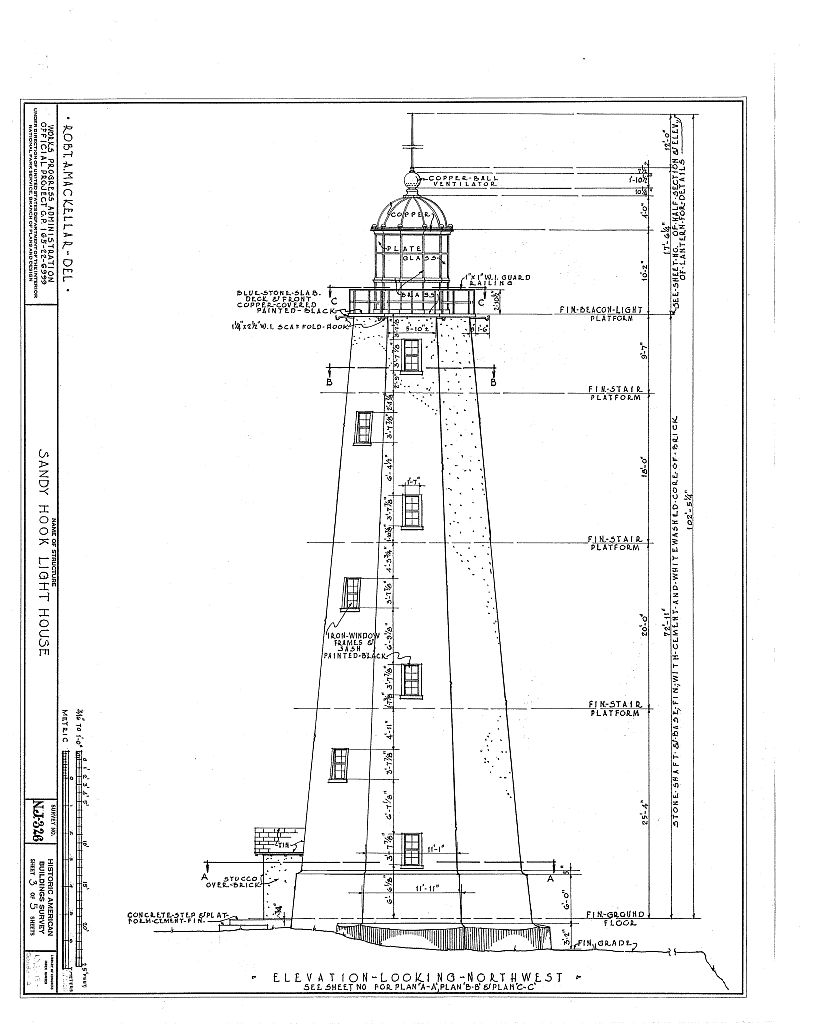
The man who built it was a New York stonemason named Isaac Conro, and he built it to last in a way that reads almost as stubbornness. It is still standing. That is the fact that ought to stop you. The tower lit on that June evening in 1764 — before the Revolution, before the country it now belongs to existed — is the same tower a boat captain steers by tonight, throwing a fixed white light nineteen miles out to sea. It was paid for by a raffle, built of stone hauled onto a sandbar, and it has outlasted every flag that has flown over it. Nearly a century after Conro finished it, in 1852, a Congressional inquiry into the state of the nation's lighthouses judged his the equal of any — one of the three best-built towers of the more than three hundred and fifty then standing.
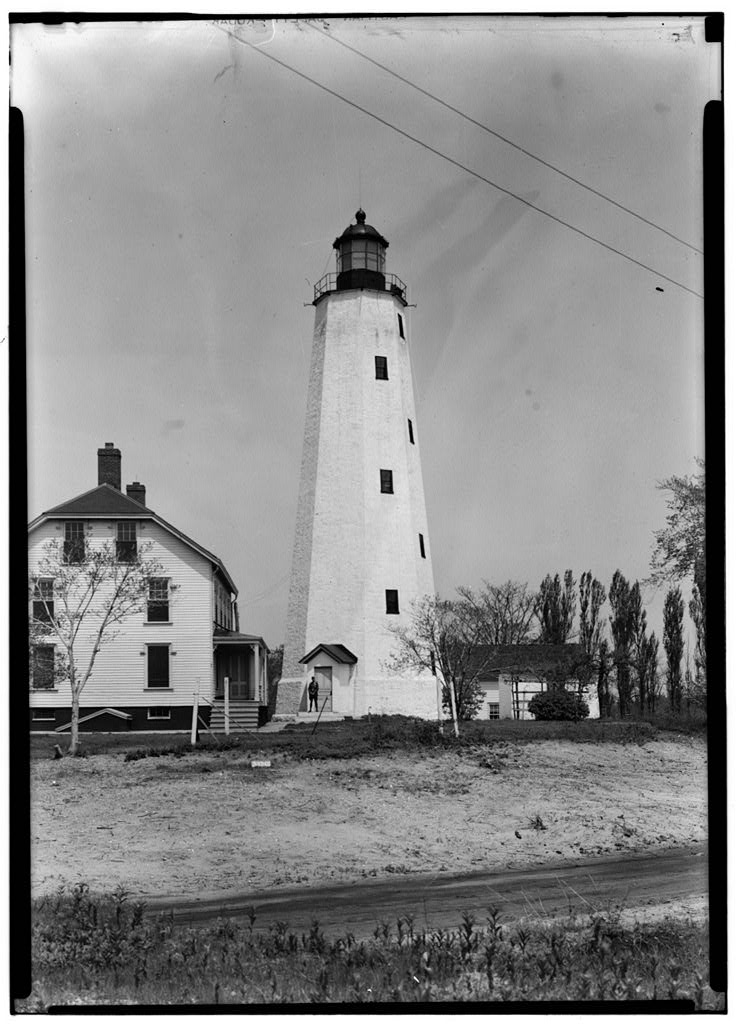
It nearly did not. Early in the Revolution both sides understood that whoever held the light held the harbor. In March 1776 a patriot raiding party rowed out and stripped it — carried off eight copper lamps and four casks of whale oil, enough to put out the eye of the harbor by hand. That June, a Massachusetts officer named Benjamin Tupper came back to finish the job and take the tower down for good. He ordered his artillery to play on it for an hour. The walls, he wrote, were so firm he could make no impression. Two feet of colonial stone on a sandspit shrugged off the cannon, a British frigate stood offshore, and Tupper withdrew. The British held what they took to calling the Refugees Tower for most of the war, a small stone fort throwing light for the king in the middle of a rebellion.
Everything else about the light has changed at least once. The whale oil gave way to a Fresnel lens in 1857 — a beehive of ground glass that bent a single flame into a beam — then to kerosene, then to electricity, then to no keeper at all when the machines learned to tend themselves. The peninsula it stands on has changed most of all, walking north grain by grain until the tip the light was built to mark, once five hundred feet away, now lies a mile and a half up the beach. The light has not moved. The land moved out from under its purpose and kept going.
On June 11, 1964 — two hundred years to the evening after the Mercury ran its notice — the Sandy Hook Lighthouse was named a National Historic Landmark. It did not need the honor to keep working. It had been doing the one thing it was raffled into existence to do, every night for two centuries: standing at the first door of the harbor, telling the ships where the sand is.