Chapter 7

The Twin Lights Century

1828–1949 · America's optics-and-signals lab

The most technologically important lighthouse in America, on Highlands' hill.

The Twin Lights of Navesink at night — two brownstone towers on the Highlands bluff with a beam sweeping the harbor, ca. 1900

Placeholder illustration for Phase 0 — replace with archival photograph before publishing.

The most technologically important lighthouse in America stood on a Highlands hill, and every American lighthouse of consequence between the Civil War and radar owed something to it. That is a sentence that will read as exaggeration to anyone who has not followed the drumbeat of the firsts. It should not.

First American Fresnel lens. First kerosene illumination. First electrified lighthouse. First practical U.S. wireless demonstration. First site to host the Army radar experiments of the nineteen-thirties.

Optics, then oils, then electricity, then radio, then radar. The same site each time. The chapter is the drumbeat.

Placeholder narrative for the Phase 0 prototype. Real copy draws on the Twin Lights Historical Society Collection, the 2006 National Historic Landmark nomination file, and the Marconi Company records. Keeper-family folklore appears here as folklore, flagged as such per the /about page's verification standards.

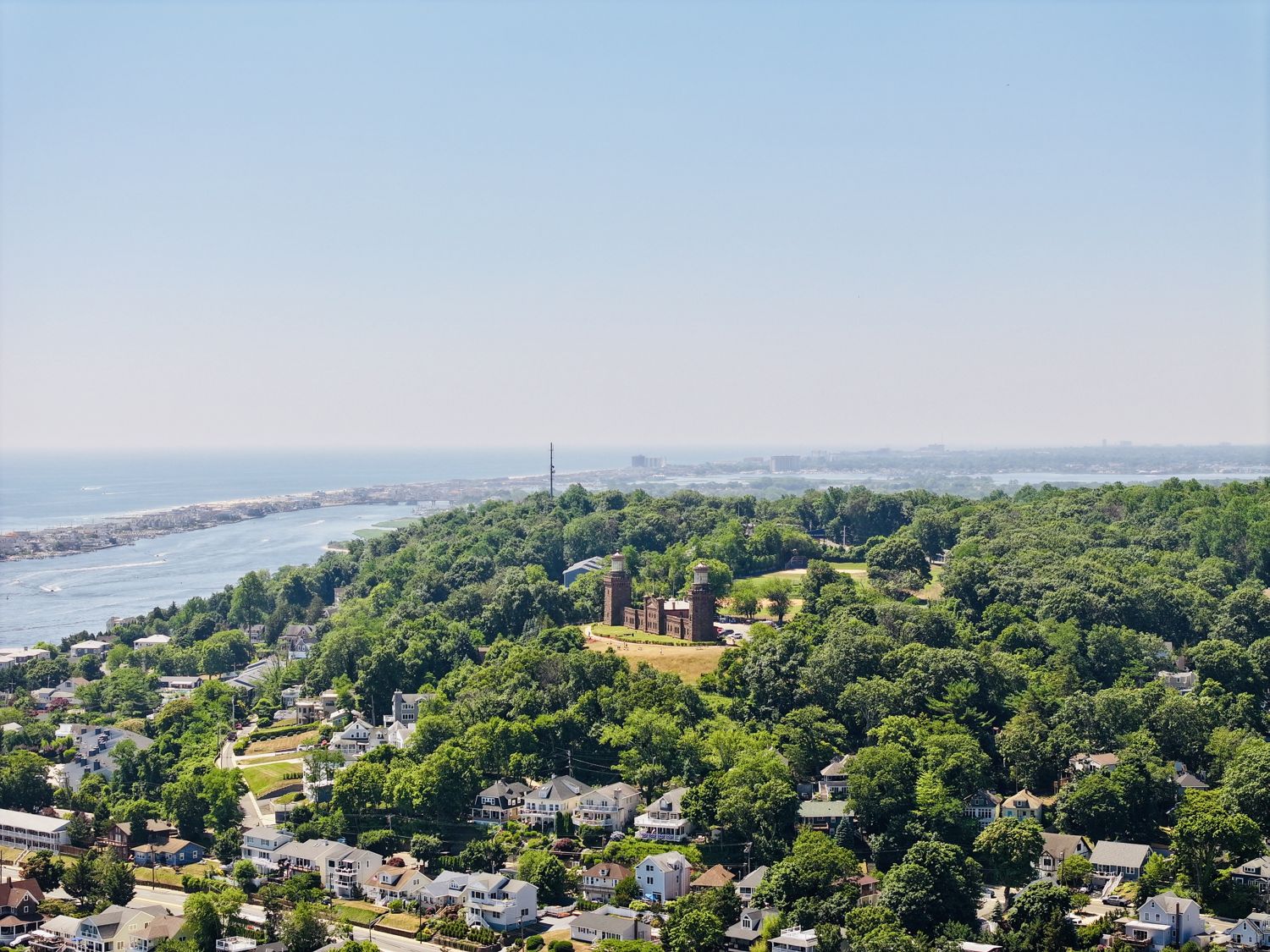
The two beacons first lit on the bluff in eighteen twenty-eight were wooden, small, and largely forgotten a generation later. The 1862 rebuild is what the town remembers. Joseph Lederle's design placed an octagonal south tower and a square north tower at the ends of a long masonry keeper's-quarters range, all in local brownstone, all still standing. The fortress-look is not accidental. The Union Army had been on the Hook for a year when construction started; the country was still at war when the towers were topped out.

The 1861-vs-1862 date question in the record is a shorthand: state records vary by which date is treated as commissioning, foundation- completion, or beacon-first-lit. The NHL nomination sets it at 1862. This chapter follows that.

The Twin Lights brownstone by day — the 1862 rebuild, keeper's quarters between two towers, seen from the Sandy Hook side

The rebuild that outlasted every subsequent aid it fed.

Placeholder — stand-in for NHL nomination photography.

A cross-section detail of a Fresnel lens installed at Sandy Hook in 1841 — concentric prismatic rings of glass
COLORIZED

Placeholder — stand-in for USLHS technical drawing.

The optical technology of every American lighthouse for the next century begins here.

Augustin-Jean Fresnel published his design for the compound-lens lighthouse optic in eighteen twenty-two. It was in operational service in France within a decade. The United States took longer. The optic was expensive; the U.S. Lighthouse Service had a reactionary champion in Stephen Pleasonton, Fifth Auditor of the Treasury, who preferred the cheaper Argand-lamp reflector system already in use.

Sandy Hook was the exception. In June eighteen forty-one an imported first-order Fresnel lens was installed at the Sandy Hook Light — the first in operational use in the country. Twenty-four concentric prismatic rings of glass, six feet across, driven by a mineral-oil lamp; range approximately twenty-four miles. The rest of the American lighthouse system followed by mid-century, but Sandy Hook was first.

The signal geography moves outward through the century.

A first-order Fresnel in eighteen forty-one projects a beam that covers the shipping approach to New York with a fixed 24-mile arc. In eighteen ninety-eight the south tower is electrified — twenty- five million candlepower, a bivalve rotating light visible for astonishing distances (the record cited in the NHL file is a verified sighting from seventy nautical miles). A year later Marconi runs the first practical U.S. wireless demonstration from Twin Lights, reporting the America's Cup race live to shore. In the nineteen-thirties, the Army sets up the earliest of its "mystery ray" experiments — radar prototypes — on the same bluff.

The map above traces the sequence.

The Liberty Pole was one hundred and thirty-five feet tall. It stood on the Twin Lights bluff for exactly the reason a lighthouse stood there — the elevation, the harbor view, the sight-line to the approaching ships. On April twenty-fifth, eighteen ninety-three, its dedication ceremony hosted the first official national reading of Francis Bellamy's new Pledge of Allegiance, addressed to a crowd that stretched down the road.

The pole was placed here on purpose. In eighteen ninety-three most immigrants arriving at New York were still spending their first American day on a ship idling in the harbor waiting for the Ellis Island barge; they saw the Twin Lights first. Bellamy's committee wanted the pledge read where they saw it. It was.

The pole itself is gone. A modern flagpole and an interpretive marker stand where it was. The bluff is otherwise unchanged.

The dedication of the 135-foot Liberty Pole at Twin Lights, April 25, 1893, with a crowd and the new pledge of allegiance being read for the first time, colorized
Then COLORIZED

Placeholder — stand-in for Twin Lights Historical Society Collection.

Now

Placeholder — stand-in for ATH matched shoot.

Guglielmo Marconi was twenty-five years old when he set up his first American demonstration wireless station on the Twin Lights bluff in September eighteen ninety-nine. His equipment reported the America's Cup races between Columbia and Shamrock to a New York Herald office in Manhattan, and — more consequentially — received ship-to-shore telegrams for the first time in U.S. commercial use.

Twenty-two years later Marconi's company employed twelve thousand people. The technology that made that possible was demonstrated here.

The south tower was electrified in eighteen ninety-eight, the north tower deactivated the same year. The south tower ran on electricity until nineteen forty-nine, when the whole complex was automated, and until nineteen fifty-two, when it was discontinued as a primary aid. Ten years passed. In nineteen sixty-two the state relit the north tower as commemoration and opened the site as a museum. It still burns.

Every ship still entering New York Harbor passes within sight of the light Marconi's wireless signal traveled from. That is not sentiment. That is geometry.