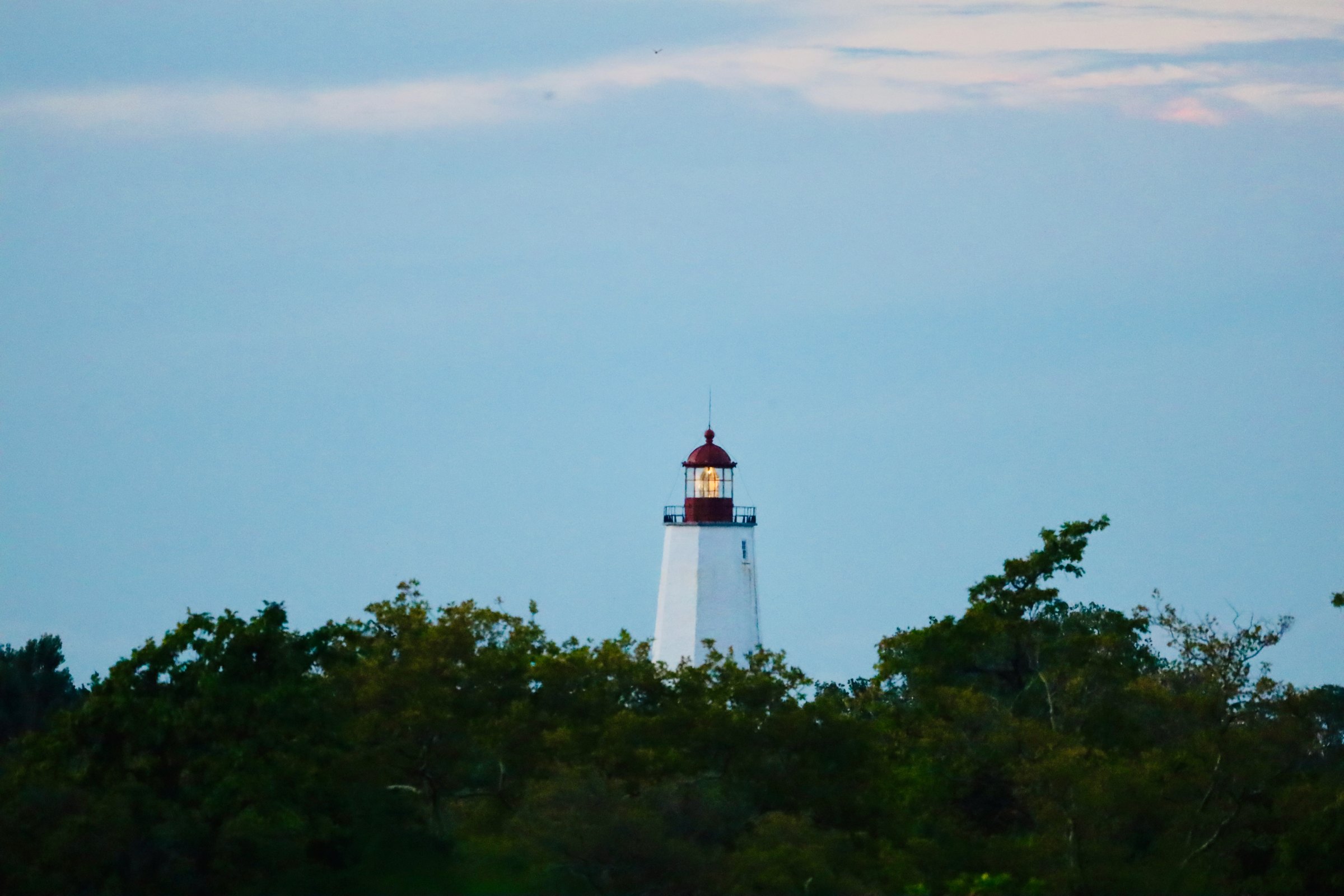
New York paid for it. It has stood in New Jersey ever since.
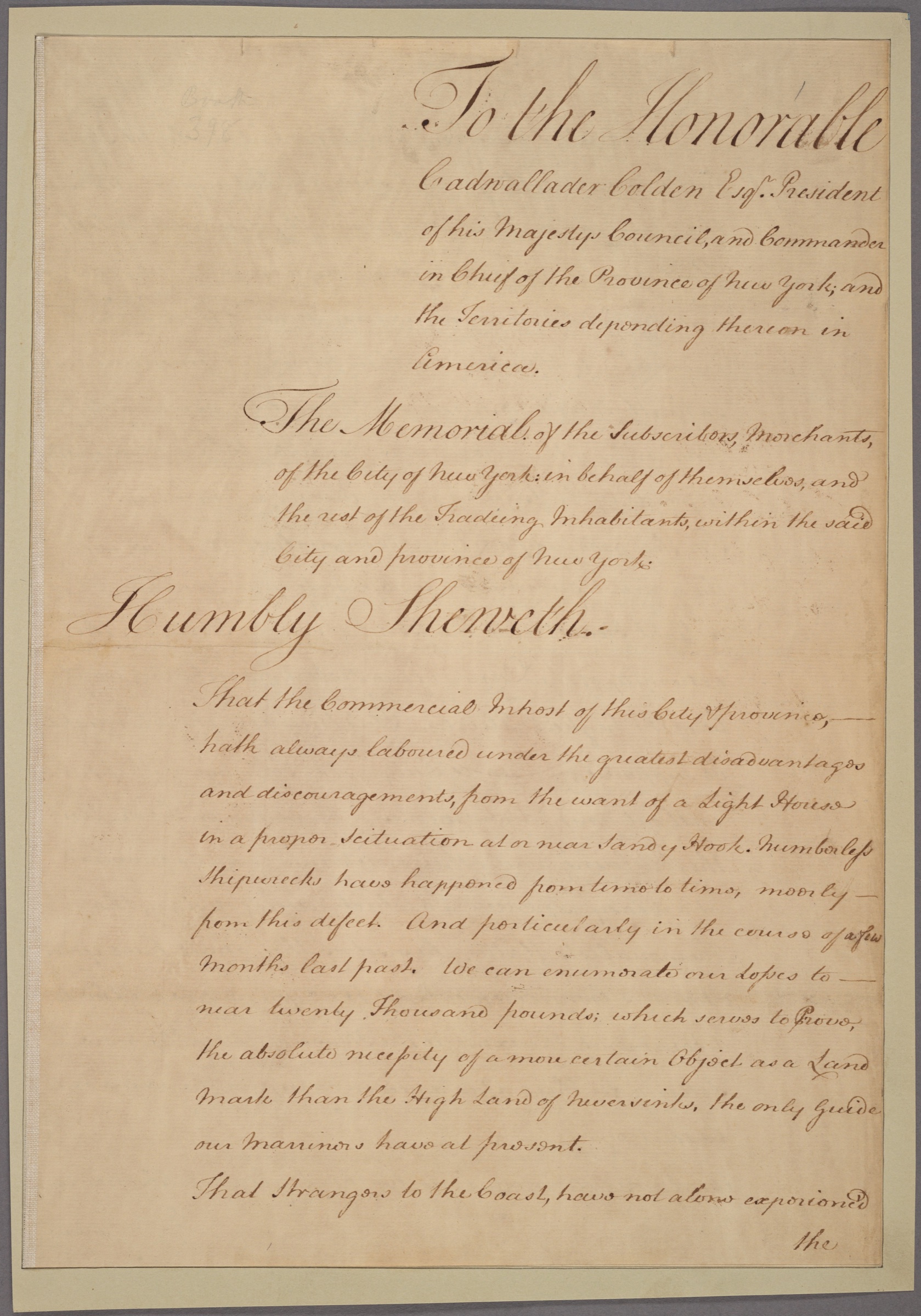
In 1761 forty-three New York merchants petitioned the Colonial Assembly.[1] They had lost too many ships on the shoals off Sandy Hook, and the shoals were not in their colony. The Assembly authorized a lottery to raise up to three thousand pounds. The first drawing fell short. It covered the land — four acres of what the deed calls barren, sandy soil, bought from Robert and Esek Hartshorne on May 16, 1762, for seven hundred and fifty pounds. Two more drawings, in June and October of 1763, paid for the tower.[1]
Isaac Conro, a stonemason from New York City, built it out of rubblestone.[2] Octagonal, twenty-nine feet across at the base and fifteen at the top of the wall. Nine stories. A hundred and three feet from the ground to the top of the lantern.
It was lit on the evening of Monday, June 11, 1764. The New York Mercury described it a week later: an iron lantern seven feet high, topped with copper. Forty-eight oil blazes.[3]
They called it the New York Lighthouse. It stood five hundred feet from the tip of the Hook, and every ship that came into the harbor paid three pence a ton to keep it burning.
It is burning tonight.
Twelve years later three hundred men came up the beach in the dark to knock it down, and could not. Nobody could. That is the thing to carry through the seven years that follow — the tower was never the problem. The tower was fine. It was everything that gathered around it that came apart.
Merchants of the City of New York · to Cadwallader Colden, acting Governor of New York · ca. 1761–1764 · scan from the New York Public Library. Public domain.
*The paper that started it — New York's merchants asking the Crown's governor for a light on New Jersey's sand.*
Eight lamps and four casks
March 1776, and everyone on both sides knew the British fleet was coming.
New York's Provincial Congress resolved to put the light out before it arrived. Major William Malcolm's orders are dated March 6 and they are not subtle about the assignment: dismantle the lighthouse at Sandy Hook.[4] Two days later a party reached the tower, carried off eight copper lamps and four casks of whale oil, and broke the glass in the lantern.[5]
It worked. The approach to New York Harbor went dark.
It stayed dark about twelve weeks. The British came, repaired the lantern, and had the light working again by June — an American lighthouse guiding Royal Navy transports into New York, which is what it would go on doing for the next seven years.
Taking the lamps out is not the same as taking the tower. Nobody ever managed the second thing.
On the record
At ten in the morning on June 21, 1776, a Massachusetts officer sat down on Sandy Hook and wrote to George Washington to explain why the lighthouse was still standing.
Benjamin Tupper, lieutenant colonel of the 21st Regiment, had crossed from Perth Amboy with about three hundred men and two six-pound brass cannon on barges.[6] He landed two evenings before the attack. At four in the morning he brought his party to within a hundred and fifty yards of the tower without being seen. Then he walked up to it with one officer and asked to speak with the commanding officer.
His own account of what happened next:
I advanced with an officer & desired to Speak with the Commanding Officer and after a few words he fired Several Shot at me but as God would have it he mist me I returnd to my party and ordered the Artillery to play which Continued an hour, but found the walls So firm I could make no Impression[7]
Six-pound shot. A hundred and fifty yards. An hour of it. No impression.
He held the ground about two and a half hours, taking fire from two men-of-war on one side and the lighthouse on the other, and came away without losing a man — not one killed, not one hurt badly enough to send to a surgeon. Then he wrote the line that belongs to this town more than any other in the letter:
it is a little Straing I received no Asistance from the jersies tho earnestly requested[7]
Somebody wrote the answer on the outside of the letter. On the addressed cover, in the hand of Robert Hanson Harrison, Washington's secretary, dated the 22nd: wrote him to desist from the enterprise, as it seemed dangerous and not to promise success.[8]
Turn the sheet over and the war is on both sides of it. One face says the walls held. The other says stop trying.
Three days later an unsigned letter from Sandy Hook ran in the New-York Gazette and Weekly Mercury, describing the same morning in almost the same words. The editors of Washington's papers have no doubt Tupper wrote it. The published version adds one line the private one leaves out: after his men had rested, he sent fifty of them out to see for game.[9]
He meant the British.
Five more tries followed, including one on July 3. The walls stayed shut. The dents his guns left were still visible in the masonry three-quarters of a century later, until the repairs just before the Civil War, when the walls were thickened over them.[10]
Refugee Town
A Middletown militiaman named Richard Sutphin watched the British take the lighthouse and turn it into a fort.[11]
They fortified the light and kept it. They called it the Lighthouse Fort. Others called it Refugees Tower.[12]
A town grew around it.
Loyalist families driven out of Monmouth County came out to the Hook because it was the one piece of New Jersey the war could not reach. They built a settlement at the base of the tower and the records call it Refugee Town.[13] Many of the people who came were formerly enslaved, who had made their way toward the British lines on the promise of freedom and found it at the end of a sandbar under a British flag.[14]
It was not a soft place and it was not an innocent one. Raiding parties went out from it across the bay against Patriot positions. Loyalist middlemen called London Traders moved goods through it.[13] The New Jersey Gazette, writing from the mainland, dismissed it as a place where horse thieves resort.[14]
For seven years this was the closest thing to a functioning town on the Hook. A few hundred people who had lost their houses twelve miles away, living within sight of them.
What became of them all after 1783 is a piece of this we still owe you. If your family carries any part of it, we would like to hear it. Tell us what you know.
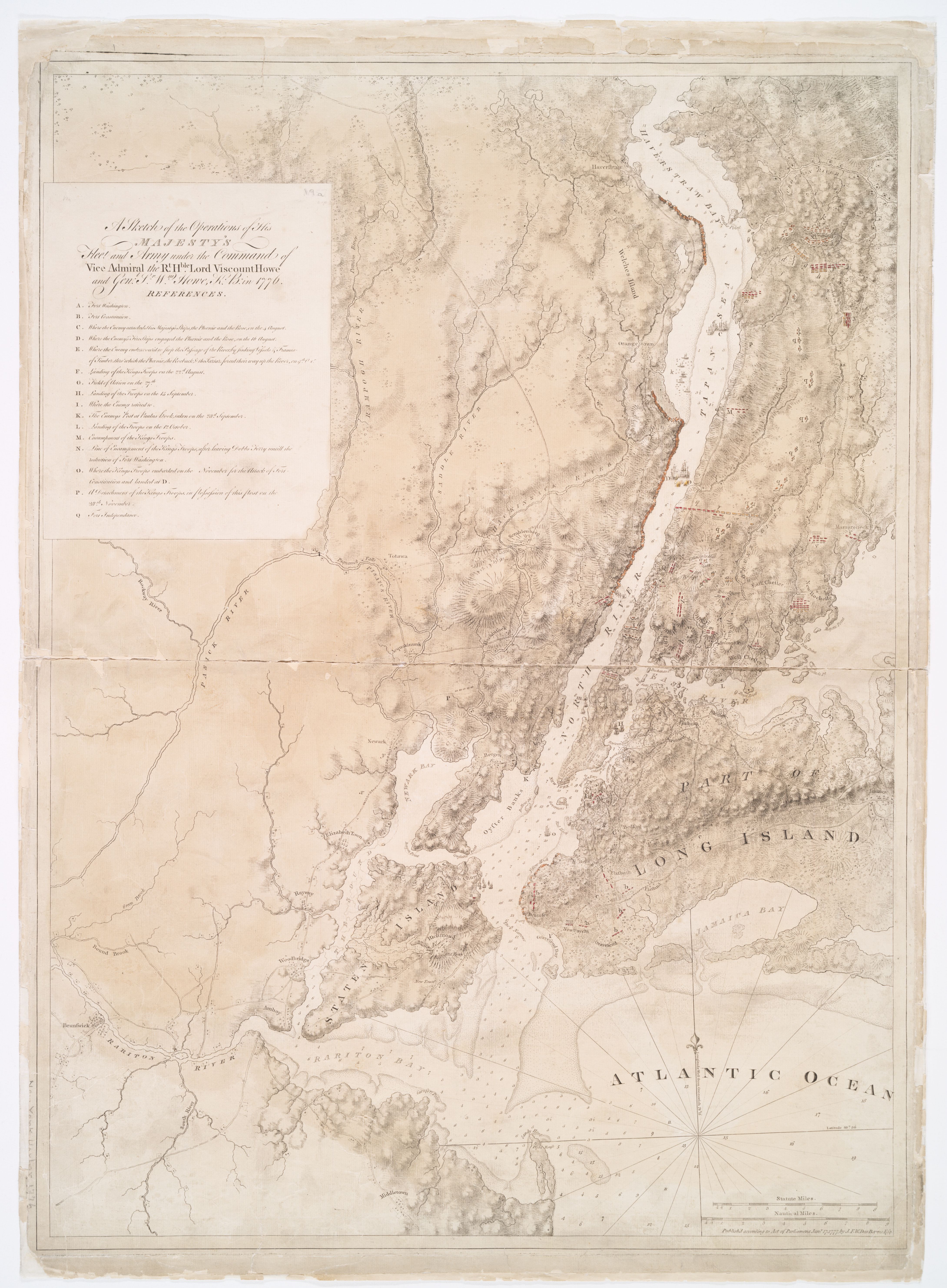
Joseph F. W. Des Barres · from the Atlantic Neptune · published 17 January 1777 · scan from the New York Public Library. Public domain.
*The Hook as the British held it — the entrance to the harbor, the fleet inside, the lighthouse a working seamark for the Royal Navy.*
A war on the Hook
Five points, one polygon, seven years.
Signature · Huddy Park
Joshua Huddy was forty-six years old and everybody called him Jack.
On March 24, 1782 — five months after Yorktown, when the war was supposed to be finished — about a hundred and twenty British and Loyalists took the blockhouse he commanded at Toms River and burned the village around it.[15] Huddy was captured and taken to New York.
On the morning of April 12 a party of Monmouth County Loyalists took him out of prison and put him in a boat. They were refugees from the Hook. The man leading them, Richard Lippincott, had been driven out of the same county Huddy came from.[15] They crossed the bay and landed on the beach at the foot of the Navesink hills.
They let him write his will first. He wrote it on the head of a barrel, sitting under the rope.[16]
The men who found him that afternoon found a makeshift gallows, an overturned barrel, and a note pinned to his breast. It opened with the refugees declaring they had long watched their brethren murdered and had resolved to make an example. It closed with four words.[17]
Up goes Huddy for Philip White.
They cut him down the same day and carried him to Old Tennent Church in Freehold. He is buried there. Nobody now knows where in the yard.[17]
The stone was set up by the Sons of the Revolution in New Jersey. The inscription says the British authorities repudiated but did not atone for that crime.[18]
There is no known likeness of Joshua Huddy. Every picture of him is somebody's guess.
Coda
The lighthouse was returned to American authority in 1783.
It has burned, with wartime interruptions, since 1764. A third-order Fresnel lens went in in 1857. Kerosene replaced whale oil in the 1870s. Electricity came in 1925, automation in 1965.[19] It came through Hurricane Sandy.
The Hook itself has moved out from under it. In 1764 the tower stood five hundred feet from the tip. The currents have been carrying sand north ever since, and it now sits about a mile and a half inland.[20] The ocean walked away from it and it stayed where it was.
Every chapter after this one has it somewhere in the background. Twin Lights, Highland Beach, the Rum Row anchorages, the Fort Hancock parade ground, the photo map — the small dot at the north end of the peninsula is the 1764 tower.
It has been the fixed point of every era of what happened here.
Sources
Sandy Hook Lighthouse. US-Lighthouses.com. Source for the 1761 petition of forty-three New York merchants, the three lottery drawings, and the £750 four-acre Hartshorne deed of May 16, 1762.
↩
Sandy Hook Lighthouse. Lighthouse Friends. Source for Isaac Conro, the New York City stonemason who built the tower.↩
Sandy Hook Light · history bulletin. National Park Service, Gateway NRA. Carries the New York Mercury's June 18, 1764 description of the new tower — iron lantern seven feet high with a copper top, forty-eight oil blazes, nine stories, 103 feet bottom to top.
↩
Major William Malcolm's orders, March 6, 1776. Revolutionary War New Jersey. The Provincial Congress order to dismantle the light at Sandy Hook.↩
Eric Jay Dolin. Brilliant Beacons — A History of the American Lighthouse. 2016. Source for the March 8, 1776 raid inventory — eight copper lamps, four casks of whale oil, the broken lantern glass.↩
“On the crossing from Perth Amboy”. The roughly three hundred men and the barges across from Perth Amboy.↩
Benjamin Tupper to George Washington, 21 June 1776. Founders Online (Washington Papers 03-05-02-0043). LinkThe dispatch itself, original spelling retained in the pull quotes — the 150-yard advance, the hour of six-pound fire, "the walls So firm I could make no Impression," and the line about no assistance from the Jerseys.
↩
Washington Papers editorial note, 03-05-02-0009. Founders Online. LinkThe order to desist, and Robert Hanson Harrison's memorandum of the 22nd on the letter's addressed cover.
↩
June 24, 1776, “Unsigned letter from Sandy Hook”. Tupper's anonymous published account, which the Washington Papers editors regard as certainly his; adds the line about sending fifty men "to see for game."
↩
Sandy Hook Lighthouse. Legends of America. The dents stayed visible until the walls were thickened just before the Civil War.↩
Tupper's attack on the Sandy Hook lighthouse. Monmouth County Historical Association · 250 series. LinkPlaces Tupper at Perth Amboy with Massachusetts Continentals and whaleboats facing the frigates Phoenix and Asia, and carries the Middletown militiaman Richard Sutphin's account of the British turning the lighthouse into a fort.
↩
The Lighthouse Fort at Sandy Hook. The Liberty Trail. The fortified light known as the Lighthouse Fort, or Refugees Tower.↩
Refugeetown and the London Traders. Monmouth County Historical Association · 250 series. LinkThe Loyalist settlement at the base of the tower and the illegal trade run through it.↩
Michael S. Adelberg. The Loyalist settlement at Sandy Hook. The Keeper's Log · U.S. Lighthouse Society. 1995. unverifiedSpecialist treatment of Refugee Town, via 943thepoint — the formerly enslaved population who came to the British lines, and the New Jersey Gazette's "where horse thieves resort." Population figure and the 1783 disposition of the settlement are withheld pending the article itself.
↩
The hanging of Joshua Huddy. Monmouth Timeline. The March 24, 1782 capture at the Toms River blockhouse, and the Hook refugees under Richard Lippincott who took Huddy across the bay.
↩
“Joshua Huddy's last will”. Huddy wrote his will on the head of a barrel, sitting under the rope.↩
Joshua Huddy — the placard and the burial. Founders Online / Wikipedia. The full text of the note pinned to Huddy's breast, closing "Up goes Huddy for Philip White," and the burial at Old Tennent Church in Freehold, the grave now lost.
↩
Joshua Huddy memorial · inscription. The Historical Marker Database (HMDB markers 139186, 5657). LinkThe stone set up by the Sons of the Revolution in New Jersey, and its inscription on the crime repudiated but not atoned for.↩
Sandy Hook Lighthouse · history. National Park Service. The third-order Fresnel lens (1857), kerosene (1870s), electrification (1925), and automation (1965).↩
Sandy Hook Lighthouse. Sea the Lights / Monmouth Timeline. The June 11, 1964 National Historic Landmark designation and the northward accretion that left the tower about a mile and a half inland.↩